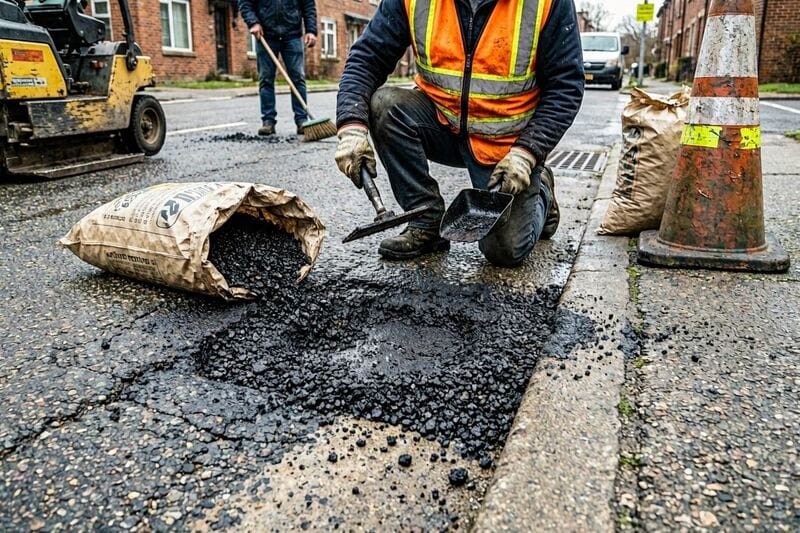
If you need the short answer, cold patch asphalt usually lasts from a few months to a couple of years, depending on traffic, moisture, patch depth, compaction, and the condition of the base underneath. It is best understood as a temporary or interim repair, not the longest lasting fix for a failing asphalt surface.
The Federal Highway Administration notes that pothole patches are intended to be temporary repairs, though higher quality materials and proper placement can keep some patches in service for several years.
That practical reality matters. If you are filling a pothole to make a surface safer today, cold patch can be the right move. If you are trying to restore structural integrity and avoid repeat failures, the better long term path is often proper surface preparation, milling, and resurfacing.
For Florida property owners, facility managers, and contractors, that distinction is even more important. Heat, rain, standing water, and repeated traffic loads can shorten the service life of a weak patch. Water infiltration is a major source of pavement problems, and low density asphalt is more vulnerable to water ingress, raveling, and cracking.
Cold patch asphalt does not have one universal lifespan because it is used in very different conditions. In the field, most patches fall into one of these ranges:
That last point is not guesswork. In a Federal Highway Administration pothole repair brief, researchers reported that pothole patches are intended to be temporary, but some high quality repairs remained in service for several years. The same brief states that 56 percent of all patches survived until the last round of performance monitoring, showing that material quality and repair procedure make a major difference.
So if you are asking, “How long does cold patch asphalt last?” the best honest answer is this:
Cold patch lasts as long as the repair conditions allow, but it should not be your default plan for a permanent pavement solution.
Cold patch is popular because it is convenient. It can be placed quickly, often with minimal equipment, and it helps restore safe access fast. But convenience is not the same as durability.
Here are the biggest reasons cold patch tends to fail earlier than a more permanent repair:
Water is one of asphalt’s biggest enemies. Moisture infiltration contributes to loss of strength and ongoing pavement deterioration. Once water reaches the patch edges or the weakened base beneath, the patch can loosen, ravel, or sink.
A pothole is rarely the whole problem. In many cases, the surface failure signals that the pavement around it or below it is already compromised. A temporary patch may fill the void, but it does not rebuild the underlying structure.
Asphalt density is critical to long term durability. If the patch is not compacted well enough, it will contain more air voids and be more susceptible to premature failure.
Cold patch in a low traffic corner of a lot may hold much longer than the same patch in a truck lane, loading area, or roadway wheel path. Repeated loads push the material down, shift it sideways, and expose the edges.
If you want the longest possible life from a cold patch, these are the factors that matter most.
A Minnesota transportation research summary on pothole patching best practices found that cold mix patches should be placed only in shallow potholes of 2 inches or less, and deeper repairs should be installed in two compacted lifts to reduce dishing and settlement.
Not all cold patch products perform the same. Using better materials reduces repeat patching and often lowers overall cost, even when the mix itself costs more up front.
A repair that is cleaned, properly filled, and compacted will usually outlast a simple throw in and drive away patch. Research tracked by federal and state transportation agencies consistently shows that procedure matters, not just material.
Rain, humidity, and ponding water put more stress on a patch. In Florida, surfaces that do not drain well can fail sooner because moisture keeps working into the edges and underlying layers. That is one reason surface prep and drainage awareness matter so much for lasting pavement work.
Passenger cars are one thing. Delivery vans, garbage trucks, heavy haul equipment, and constant turning movements are another. The more severe the loading, the shorter the likely service life.
Cold patch is not bad. It is simply the wrong tool for some jobs.
It makes sense when you need to:
In other words, cold patch is valuable when speed matters most.
If the same pothole keeps coming back, the issue is usually bigger than the hole itself. Repeated patch failures often point to edge breakdown, moisture intrusion, base problems, or broader surface distress.
That is where Native Construction stands apart. Instead of treating every pavement problem like a bag of patch material will solve it, Native focuses on the work that supports a longer lasting pavement system:
Native’s crews handle FDOT projects, use Trimble UTS guided milling systems for millimeter level grade control, and provide in house resources that reduce rework and keep projects on schedule. That combination is a major advantage over providers that only address the surface symptom and leave the deeper pavement issue untouched.
If you are deciding whether to patch or pursue a more durable repair, use this simple framework:
That second list is where long term value usually lives. A patch may cost less today, but repeated patching can cost more over time in labor, disruption, and user delay. The Federal Highway Administration specifically warns that poor quality patching materials and repeat repairs can erase any apparent savings from a cheaper short term fix.
If a temporary repair is the right call for now, you can still improve performance by following proven best practices:
Cold patch asphalt can be useful, but it is rarely the finish line. For many properties and roadway projects, the real goal is not just filling a hole. It is restoring a stable, well prepared surface that can support new pavement and stay in service longer.
That is where Native Construction brings more value. With FDOT level experience, precision asphalt milling capability, immediate clean up support, and in house coordination, Native helps contractors and owners move from temporary fixes to pavement work that is prepared correctly from the start.
If your cold patch keeps failing, the pavement is telling you something. Listen to it early, and you can often prevent a much bigger repair later.