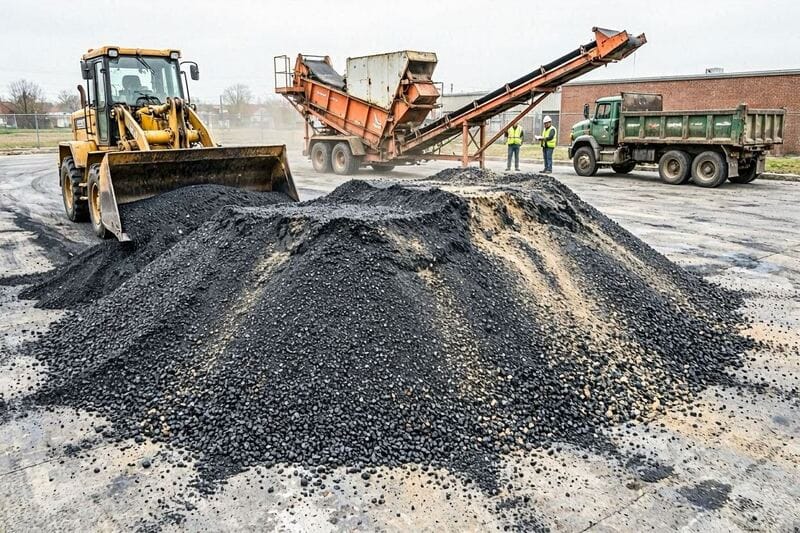
If you are choosing asphalt millings for a driveway, parking area, private road, or temporary access route, here is the short answer: screened asphalt millings are more uniform, easier to grade, and usually better when appearance and finish matter. Unscreened millings are less processed, typically more variable in size, and often make sense when cost and bulk coverage matter more than a polished surface.
That difference sounds simple, but it affects compaction, drainage, installation time, surface smoothness, and long term performance.
For most finished surfaces, screened millings are the better fit because the material has been processed to remove oversized chunks and create a more consistent blend. For lower budget projects, base layers, farm roads, and rough access roads, unscreened millings can still be a practical option if they are placed and compacted correctly.
At Native Construction, that distinction matters because material quality starts long before the truck arrives. Our team specializes in asphalt milling, milling clean up, and precision pavement preparation across Florida. That means we understand not just what millings are, but how they are produced, handled, and reused in ways that support better project outcomes.
Asphalt millings are reclaimed asphalt pavement, often called RAP. The material comes from existing asphalt surfaces that are removed by milling machines during resurfacing or reconstruction. Instead of sending that material to a landfill, contractors can reuse it in new asphalt mixes or as a stand alone aggregate like driveway surfacing and road base.
That reuse is common across the paving industry. According to the National Asphalt Pavement Association, asphalt pavement is the most recycled material in the United States, and reclaimed asphalt pavement is routinely reused in roadway construction and maintenance.
The Federal Highway Administration also recognizes reclaimed asphalt pavement as a valuable material that can reduce virgin aggregate demand and support cost effective pavement construction when processed and used properly.
The main difference is processing.
Screened millings have gone through a screening process that separates oversized pieces and creates a more controlled material size.
In practical terms, that usually means:
Unscreened millings come directly from the milling operation with minimal additional processing. They often contain a wider range of particle sizes, from fine material to larger chunks.
That usually means:
Screening improves consistency. Consistency matters because surface performance depends heavily on gradation, or the distribution of particle sizes in the material.
According to the Asphalt Institute, aggregate gradation plays a major role in density, void structure, and overall performance in asphalt related applications. While screened and unscreened millings are not identical to engineered hot mix asphalt, the same basic principle applies: more consistent sizing generally gives installers more control over placement and compaction.
That is why screened millings are usually the better choice for:
Unscreened millings are often better suited for:
In many cases, screened millings compact more predictably because the material is more uniform. That does not automatically mean unscreened millings cannot perform well. It means installers may have to work harder to break down large chunks, redistribute fines, and achieve an even surface.
Compaction quality depends on several factors:
The Federal Highway Administration notes that reclaimed asphalt pavement properties can vary based on source, processing, and handling, which is one reason quality control matters.
For property owners, the takeaway is simple: if you want a tighter, more uniform finish with fewer surprises, screened millings usually make the job easier.
People often assume asphalt millings behave exactly like fresh asphalt. They do not. Millings can create a durable surface, but performance depends on gradation, compaction, and drainage design.
Because screened millings are easier to grade, they often make it easier to establish a consistent crown or slope. That can help move water off the surface more effectively.
Unscreened millings can still drain well if installed properly, but larger chunks and uneven distribution may create dips or rough spots that trap water. On a driveway or parking area, those low spots can lead to rutting or soft areas over time.
Loose fines and incomplete compaction can contribute to dust or tracking. In many cases, screened material produces a neater finished surface with less loose debris after rolling, though performance still depends on placement and traffic.
Usually, yes, if the surface is meant to be finished and visible.
Screened millings often cost more because there is an extra processing step. But the lowest material cost does not always mean the lowest installed cost.
If unscreened material requires:
then the price advantage can shrink quickly.
For projects where surface quality matters, screened millings often deliver better value, not just a better look.
Use screened millings if you want:
Use unscreened millings if you want:
If you are unsure, think about the final expectation. If you would notice every bump when driving over it, screened millings are probably the better choice.
One point many articles miss is that asphalt millings are only as good as the process that produced them.
Poorly controlled milling can create inconsistent material, contamination, and unnecessary variability. Clean, well managed milling operations help produce reusable material that is easier to place and more reliable in the field.
That is where Native Construction stands apart.
Native Construction is not simply a reseller of leftover material. We are a Florida contractor with deep field experience in pavement removal and surface preparation. Our crews handle asphalt milling for highways, county roads, commercial sites, private developments, and other demanding projects. We also provide milling clean up services so the site is prepared efficiently for the next phase.
For projects that demand tight tolerances, Native Construction uses UTS 3D guided milling systems to achieve highly precise cuts. That level of control helps reduce rework and supports better grade accuracy on resurfacing and reconstruction jobs. For contractors and owners, that means better material handling, better pavement prep, and a more accountable process from start to finish.
A lower cost load can become expensive if it creates a rough, uneven surface that needs frequent touch ups.
Even the best millings will not perform well over a weak or poorly drained base.
Thinner, properly compacted lifts usually produce better results than dumping and rolling a deep layer all at once.
Water is still one of the biggest threats to pavement performance. The Asphalt Pavement Alliance emphasizes that drainage is critical to long term pavement life.
They are not. Source material, milling method, contamination, and screening all affect performance.
If your goal is a surface that looks cleaner, grades more evenly, and performs more predictably, screened asphalt millings are usually the better choice. Unscreened millings still have a place, especially on budget sensitive or temporary projects, but they come with more variability.
For Florida contractors, developers, and property owners, the smartest move is to work with a team that understands the full milling process, not just the end material. Native Construction brings that expertise to every job through precise milling, reliable clean up, and field proven pavement preparation. When the source, process, and execution all line up, the finished result does too.