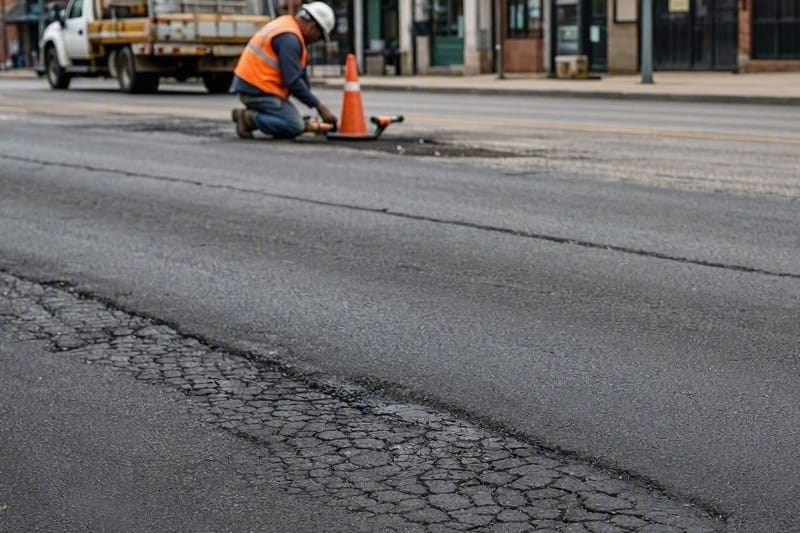
Cracks in asphalt rarely start as a cosmetic issue. In most cases, they are an early warning sign that water, traffic loads, heat, poor drainage, or movement in the underlying structure are beginning to break the pavement down. The faster you identify the crack pattern and match it to the right repair, the better your odds of avoiding costly patching, base failure, or full replacement.
For owners, property managers, municipalities, and contractors, the practical takeaway is simple. Small cracks usually call for timely sealing or surface treatment. Structural cracks usually point to a deeper problem that surface level fixes will not solve.
According to the Federal Highway Administration crack sealing guidance, crack treatments are used to keep water and incompressible materials out of the pavement system, while the FHWA pavement preservation framework makes clear that preventive maintenance is meant to preserve sound pavement, not restore lost structural capacity.
For Florida projects, prevention also depends on what happens before new asphalt is placed. Proper milling, accurate grade control, and immediate clean up all help create a better surface for resurfacing.
Native Construction stands out because the company is built around pavement preparation, not just pavement removal. Its crews handle asphalt milling, milling clean up services, and in house precision work through Native Construction service capabilities, helping contractors reduce delays, improve paving readiness, and limit the conditions that allow early cracking to return.
Asphalt cracks form when pavement can no longer flex or carry stress the way it was designed to. That stress may come from repeated traffic, oxidation and aging, low temperature shrinkage, weak support below the surface, poor drainage, or cracks and joints reflecting upward from older layers.
Crack patterns tell you a great deal about the underlying cause, which is why correct diagnosis matters before any repair is selected.
In plain terms, asphalt usually cracks for one of three reasons:
Once cracks open, water intrusion accelerates the problem. That’s one reason the FHWA technical brief on sealing and filling cracks emphasizes early crack treatment as a maintenance practice, especially before cracks widen and edge deterioration begins.
Alligator cracking, also called fatigue cracking, looks like a network of interconnected cracks that resemble reptile skin. It usually appears in wheel paths or high stress areas.
This is one of the most important crack types to recognize because it often signals structural failure. Preventive maintenance treatments cannot correct a structural deficiency, and crack sealing alone is generally ineffective once the classic alligator pattern is visible. Common causes include repeated traffic loading, a weak base, poor drainage, and localized support failure.
Best response: full depth repair of failed areas, drainage correction, and then resurfacing as needed.
Longitudinal cracks run roughly parallel to the pavement centerline or paving direction. They may form near joints, outside wheel paths, or in wheel paths.
The Pavement Interactive guide to longitudinal cracking notes that these cracks can result from poor joint construction, top down cracking, or the early stages of fatigue distress. If they are caught early and the pavement beneath is still stable, sealing may be enough. If they are tied to structural weakness, a deeper repair is usually needed.
Best response: seal early if narrow and isolated, but investigate joint quality and pavement support before assuming it is a surface only issue.
Transverse cracks run across the pavement, roughly perpendicular to the direction of travel. They are commonly associated with thermal movement and age hardening.
Transverse cracking is often caused by low temperatures, thermal cycling, shrinkage, binder hardening, or reflective movement from below. When these cracks are low severity, sealing can help keep moisture out and slow edge breakdown.
Best response: crack sealing for early stage cracks, overlay or partial reconstruction if cracking is widespread.
Block cracking forms a pattern of large rectangular sections. Unlike alligator cracking, it is usually not concentrated in wheel paths.
Block cracking is typically associated with asphalt aging and binder hardening rather than repeated traffic loading. It often appears where pavement has experienced long term oxidation or where the mix has become brittle over time.
Best response: surface renewal, selective sealing, and overlays where needed, along with evaluation of pavement age and oxidation.
Reflection cracks appear in a new asphalt overlay because cracks or joints in the underlying pavement move and telegraph upward. The FHWA identifies reflective cracking as a common issue where underlying discontinuities remain active below the new surface.
Best response: address the underlying movement before resurfacing when possible, and use the right rehabilitation strategy rather than relying on a cosmetic overlay alone.
Slippage cracks often have a crescent shape and tend to appear where vehicles brake, turn, or accelerate. They usually point to poor bonding between asphalt layers or mix instability. The Pavement Interactive classifies slippage cracking as a separate distress because it reflects a construction or bonding problem, not just age or climate.
Best response: remove and replace the affected area after correcting the bond issue.
Some asphalt surfaces crack because of age. Others fail early because avoidable issues speed up deterioration.
The most common accelerators include:
The Asphalt Institute recommends proper surface slope to avoid standing water, and FHWA preservation guidance consistently ties pavement life to timely preventive maintenance and good project selection.
The best crack prevention strategy begins long before the first visible line appears.
If the existing surface is damaged, uneven, or holding water, new asphalt placed on top will inherit those problems. Precision milling removes deteriorated material at the right depth and creates a uniform surface for the next lift. Native Construction’s asphalt milling services are designed to preserve the underlying base when appropriate while producing a clean, consistent profile for resurfacing.
Water is one of the fastest ways to shorten pavement life. Accurate slope and profile matter because drainage issues can turn small cracks into base failures. Native Construction’s in house service capabilities include Trimble UTS guided milling that helps crews hold grade within very tight tolerances, which is especially valuable on highways, municipal roads, parking lots, and airport surfaces where drainage and elevation control matter.
Dust, debris, and leftover millings can interfere with paving quality and bonding. Native Construction’s milling clean up services are built around immediate post milling deployment, which helps keep schedules moving and leaves the surface ready for paving without unnecessary downtime.
For low severity transverse and longitudinal cracks, early sealing helps limit moisture intrusion and edge raveling. The FHWA supports timely treatment as a way to improve maintenance efficiency and extend service life when the pavement is still a good candidate for preservation.
One of the biggest mistakes in asphalt maintenance is treating every crack the same way. A narrow thermal crack is not the same as alligator cracking. A reflected joint is not the same as a slippage failure. Correct identification protects maintenance budgets and prevents repeated repairs that do not address the root cause.
Many providers focus on the visible surface. Native Construction focuses on the conditions that shape long term asphalt performance underneath and before paving begins.
That matters because cracking prevention is not just about sealant. It is about precision milling, correct depth control, proper surface cleanliness, efficient handoff to paving crews, and a team that understands demanding project environments. Native Construction brings FDOT approved experience, in house resources, immediate clean up support, and UTS guided precision that helps reduce rework and improve paving readiness across Florida projects.
Asphalt cracks are not all the same, and they should never be treated as if they are. Some cracks are early maintenance issues. Others are signs of structural distress. The key is to identify the pattern, act early when preservation is still possible, and make sure the pavement is properly milled, cleaned, graded, and prepared before resurfacing begins.
When that preparation work is done right, pavement has a much better chance of resisting moisture, traffic stress, and premature cracking. This is where Native Construction delivers real value for Florida contractors, developers, and public sector projects alike.