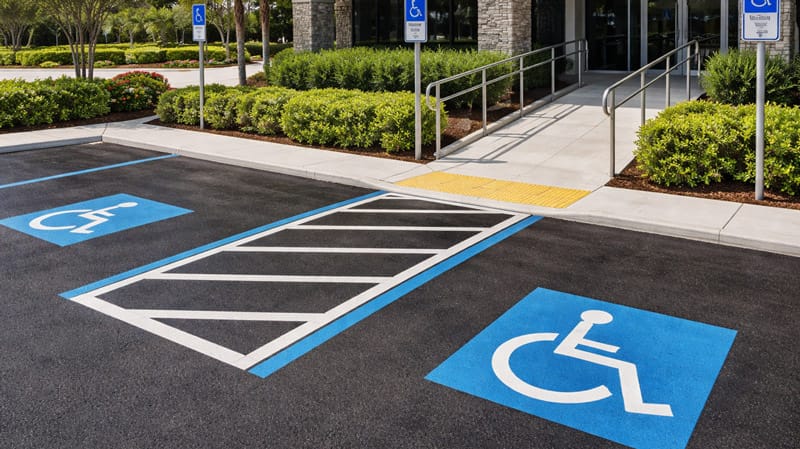
When it comes to asphalt paving, appearance isn’t the only thing that matters. Accessibility is equally important. Whether you’re maintaining a parking lot, updating sidewalks or planning a new paving project, meeting ADA (Americans with Disabilities Act) requirements is essential for creating safe, usable spaces for everyone.
ADA asphalt paving requirements ensure that paved surfaces are accessible by specifying standards for slope, surface smoothness, width, transitions and designated accessible parking and pathways for individuals with disabilities. From parking lots and sidewalks to curb ramps and pedestrian routes, ADA-compliant paving helps remove barriers for individuals with disabilities while also protecting property owners from potential liability and costly corrections.
Understanding the necessary ADA standards, the appearance of compliant asphalt surfaces and how proper design and installation impact compliance can be overwhelming without proper guidance. This blog outlines the main ADA asphalt paving requirements, clarifies where compliance is needed and emphasizes the importance of partnering with an experienced professional to ensure your pavement meets current accessibility standards.
ADA asphalt paving requirements can vary by state. According to the Florida Department of Transportation (FDOT), sidewalks, curb ramps and pedestrian routes must meet specific standards and measurements to ensure accessibility for people with disabilities.
Sidewalks should have a clear width of at least 36 inches with a maximum 2% cross slope, and walkarounds at driveways must be at least 48 inches wide. Surfaces must be firm, stable and slip-resistant. When designing accessible paths, ensure proper grading and drainage so surface slopes allow stormwater to drain without pooling. Keep the path free of obstacles and provide easy access for all users.
Curb ramps must stay within crosswalk limits, with running slopes no greater than 8.33% (1:12) and cross slopes no greater than 2%. They require top landings at least 48 inches deep and as wide as the ramp, and detectable warning surfaces (truncated domes) that contrast in color and extend the full ramp width plus 24 inches from the back of the curb. Tactile warning surfaces are often required at the base of ramps to alert visually impaired individuals.
Updated path of travel standards will require ADA-compliant routes from parking areas to building entrances to be smooth, slip-resistant and free from obstructions.
Technology will also play a larger role in ADA enforcement, enabling individuals to report violations via mobile apps and online tools. Annual compliance inspections are recommended to ensure safety and visibility.
In general, the ADA applies to government services and agencies at the local, county and state levels, including city halls, courthouses, public schools, libraries and U.S. Postal Service branches. It also applies to businesses that serve the public, such as retail stores, restaurants, hotels, banks, car dealerships, airports, theaters and entertainment venues.
The ADA emphasizes that the top priority for accessibility is ease of approach and entry, meaning paved areas leading to a building are just as important as the doors themselves. An accessible entrance is crucial for individuals with mobility disabilities, enabling safe, easy access to the building or facility.
Ensuring these surfaces meet ADA standards helps protect visitors, employees and businesses from potential liability while creating a safe, accessible environment for everyone.
Making outdoor areas accessible requires attention to every aspect of an asphalt parking lot, including parking spaces, curbs, ramps, ramp landings and access aisles.
For commercial paving projects, using high-quality materials is crucial to creating durable, ADA-compliant surfaces that meet safety and accessibility standards. A thoughtfully designed parking layout is vital, as it promotes ADA compliance and optimizes space. When necessary, updating or modifying an existing lot may be required to align with current ADA standards.
The ADA provides clear rules for both new parking lots and for re-striping existing ones. Key requirements include:
Properly designed accessible parking ensures the lot is safe, welcoming and fully compliant, giving every visitor a smooth, barrier-free path to the building.
An experienced asphalt contractor can guide you through ADA compliance, from site assessment to expert solutions for curb ramps, re-striping, surface repairs, and more to ensure all ADA requirements are met, and the surface is installed safely and correctly.
Sidewalks often separate parking lots from building entrances, but curbs can create barriers for people using wheelchairs, walkers or scooters. The ADA requires curb and sidewalk modifications to provide accessible routes, most commonly through professionally installed ADA-compliant asphalt ramps. These ramps cut through the curb and slope gently to meet the sidewalk, making entrances easier to reach.
Key elements of a curb ramp include:
Construction standards:
Well-designed ramps and curb cuts ensure ADA compliance while creating safe, accessible and welcoming entrances for all visitors.
ADA standards set rigorous requirements for slope, cross-slope, surface smoothness and transitions, so even minor paving errors can lead to noncompliance. A professional assessment is vital for determining the appropriate approach and ensuring compliance with all accessibility standards.
Local specialists like Native Construction Group understand Florida’s ADA asphalt paving requirements, conduct site audits to identify non-compliance issues and recommend solutions, and design and install pavement that meets current accessibility standards.
From proper grading and slope control to compliant parking layouts and smooth, slip-resistant surfaces, working with experienced and trusted professionals helps reduce liability, avoid costly corrections and ensure your pavement remains ADA compliant for years to come.